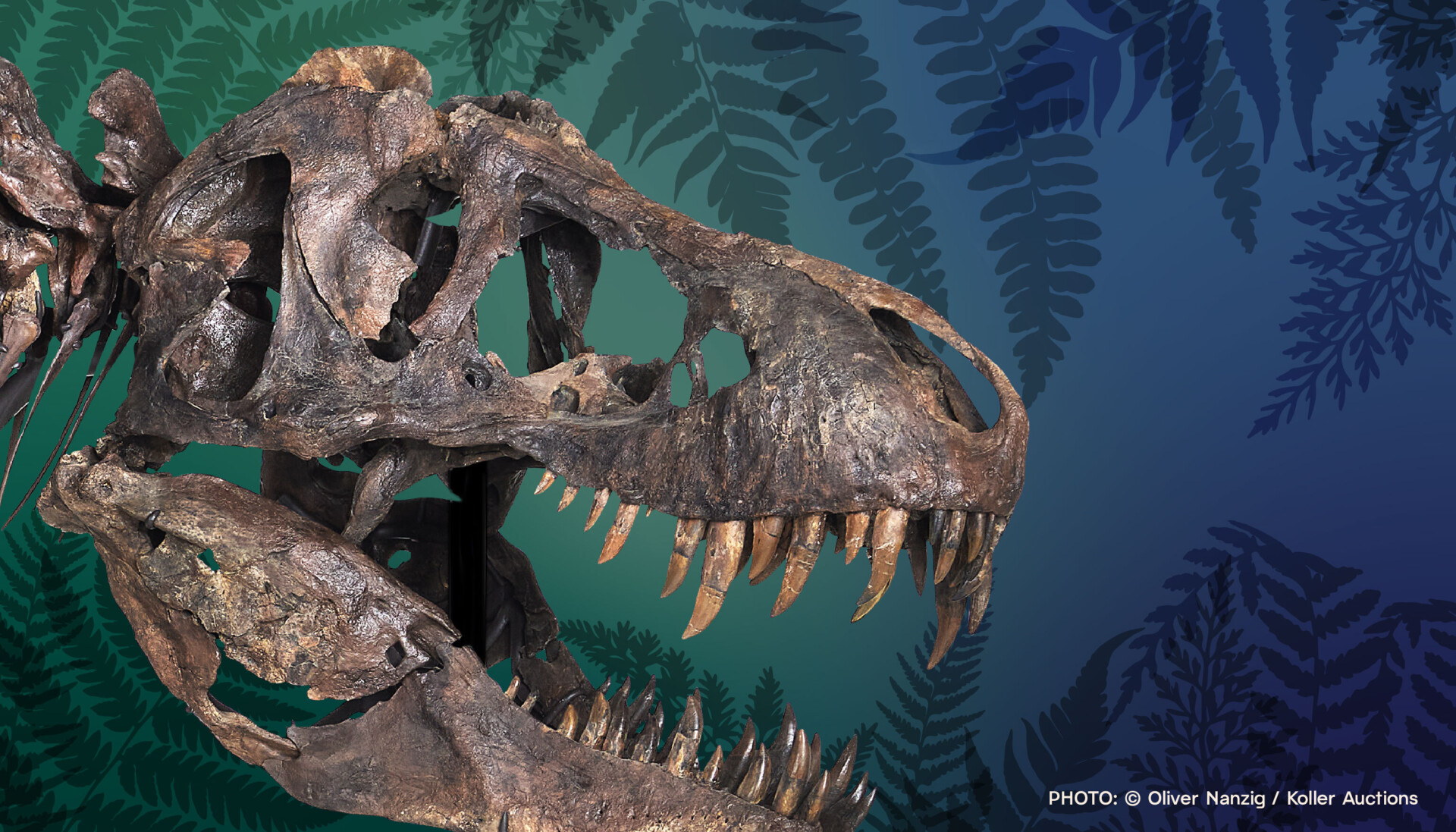
As the Bayeux Tapestry draws crowds to London, an even older star is heading to the South Coast. Trinity, featuring 293 genuine fossil bones, makes her UK public debut at Portsmouth Historic Dockyard on 12 February 2027.
The Bayeux Tapestry may be nearly 1,000 years old, but Trinity would have it for breakfast, says lead palaeontologist, Dr Nizar Ibrahim as he and his team of scientists prepare for the arrival of Trinity, a 67-million-year-old Tyrannosaurus rex that’s preparing to make her first public appearance in Britain. Tickets went on sale earlier this morning for the new interactive exhibition opening at Portsmouth Historic Dockyard on Friday 12 February 2027.
Featuring 293 genuine fossil bones, Trinity is 11.6 metres long, longer than a double-decker bus, and stands more than four metres tall. Her bite is so strong, she could bite through your car and would have weighed in at more than ten tonnes – that’s more than two Indian elephants.
Her arrival offers visitors the chance to come face-to-face with one of history’s most formidable predators while discovering what researchers are still learning from her remains.
Her UK debut was announced on Thursday 19 November at Portsmouth Historic Dockyard, with a giant, interactive light installation projected onto historic Boathouse 4. The dramatic reveal formed part of We Shine Portsmouth, the citywide light festival running until Saturday 21 November.
Why Portsmouth, not London?
A prehistoric attraction of this scale might be expected to find a home in one of London’s national museums. But Portsmouth has a compelling claim. Across the Solent, the Isle of Wight is internationally recognised for its extraordinary dinosaur discoveries, while researchers at the University of Portsmouth have helped identify previously unknown species and continue to push the boundaries of palaeontology.
Hannah Prowse, CEO of Portsmouth Historic Quarter, said:
“You might expect a T. rex of this significance to end up at the Natural History Museum or the British Museum in London. But when you look at where dinosaur discovery is happening in Britain, Portsmouth makes perfect sense. Across the Solent is the Isle of Wight, one of Europe’s richest fossil sites, and here in Portsmouth we have scientists whose work is changing what we know about prehistoric life. This is exactly where Trinity belongs.
“Portsmouth Historic Dockyard is already a place where people encounter the real evidence of the past, from the Mary Rose to HMS Victory. Trinity takes that experience back 67 million years. We’re proud to bring a world-class exhibition beyond London, one that combines genuine fossils, live scientific research and the chance for people of all ages to feel the scale of a T. rex for themselves.”
A £1.5 million transformation of the Dockyard’s Grade II-listed Boathouse 5 will provide Trinity with a spectacular temporary home. The immersive, accessible experience will trace her journey from prehistoric animal to fossil discovery and ongoing scientific investigation.
Real bones from 67 million years ago
Trinity contains 293 genuine fossil bones from three Tyrannosaurus rex specimens of comparable size, quality and geological origin, discovered in the United States between 1995 and 2013. Using more than one specimen is common in mounted dinosaur skeletons because virtually all discoveries are incomplete. Her name reflects the three individual animals represented.
Following a 2023 auction sale for more than $6 million, Trinity was acquired by The Phoebus Foundation, a public-benefit art foundation based in Antwerp, Belgium. Rather than disappear into a private collection, she has been made accessible through international exhibitions and scientific study. She has previously been exhibited in Switzerland and Denmark, but has never been on British soil.
Trinity’s arrival comes as the soaring value of dinosaur fossils raises concerns that scientifically important specimens may be placed beyond the reach of researchers and the public. The Foundation’s approach instead keeps this remarkable dinosaur in public view while scientists continue to learn from it in perpetuity.
The secrets Trinity could still reveal
At the heart of the exhibition is ongoing research led by internationally renowned palaeontologist and National Geographic Explorer Dr Nizar Ibrahim, working with PhD researchers from the University of Portsmouth. The team will investigate the animals’ anatomy, age and evidence of injury and disease preserved within the bones.
Dr Nizar Ibrahim, Scientific Director, Dinosaur Museum Bavaria (Dinosauriermuseum Altmühltal), commented:
“Tyrannosaurus rex may be the most recognisable dinosaur on Earth, but there is still an enormous amount we can learn about these extraordinary animals. Trinity gives us the opportunity to investigate evidence of growth, movement, injury, disease and survival and to move beyond the image of T-Rex simply as a giant predator.
“Visitors will be encountering genuine fossils while that investigation is still continuing. The bones are the beginning of the story, not the end: they can help us understand what these animals experienced and what their lives were really like 67 million years ago – in the age of the dinosaur.”
Dr Ibrahim, now Scientific Director at Dinosaurier Museum in Bavaria, brought the project and skeleton to Portsmouth during his tenure at the University. His work on major predatory dinosaurs, including Spinosaurus, has featured in National Geographic and the BBC’s Walking with Dinosaurs.
University of Portsmouth Vice-Chancellor, Graham Galbraith, said:
“If there’s one city in Britain where Trinity belongs, it’s Portsmouth. We look straight out across the Solent to the Isle of Wight, one of Europe’s richest dinosaur fossil sites, and our students and researchers have been at the heart of some significant discoveries made there.
“We were also the first university in the UK to offer a single-subject undergraduate degree in palaeontology, so you could say it’s in our bones. Just as importantly, we’re working to connect local schools with the exhibition and offering public talks and events with our experts, so that people of all ages can get up close to science and perhaps discover a passion that stays with them for life.”
Trinity’s story did not end 67 million years ago. The bones still have secrets to reveal, and visitors will be able to follow that science as it happens.
—
THE TRINITY T. REX EXHIBITION OPENS AT PORTSMOUTH HISTORIC DOCKYARD ON FRIDAY 12 FEBRUARY 2027.
TICKETS ARE ON SALE NOW AT WWW.TREXPORTSMOUTH.CO.UK.