
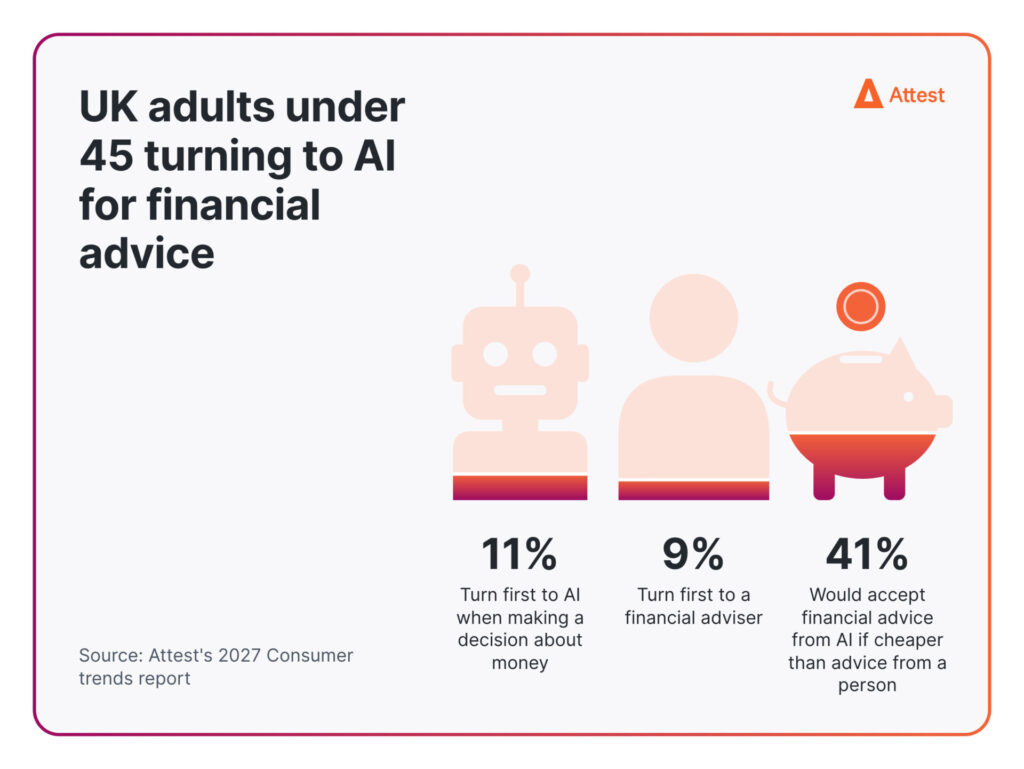
Two in five would accept financial advice from AI if it cost less than advice from a person
- 11% of UK under-45s turn first to an AI assistant for money decisions, compared with 9% who turn to a financial adviser.
- 41% under-45s would accept financial advice from AI if it were cheaper than advice from a person.
- 41% of UK adults surveyed would let AI cancel unused subscriptions without asking each time.
- 30% of UK adults would let AI switch them to a better insurance or utilities deal, rising to 54% among the heaviest AI users.
UK adults under 45 are more likely to turn first to an AI assistant than a financial adviser when making a decision about money, according to new research from consumer insights platform Attest. Some 11% consult AI initially, compared with 9% turn to a financial adviser first.
Cost could encourage further adoption. Two in five under-45s (41%) say they would accept financial advice from AI if it were cheaper than advice from a person. The findings from Attest’s 2027 Consumer trends report reveals that AI is becoming a point of contact for consumers weighing money decisions, with implications for how financial services brands reach and inform potential customers.
The under-45 findings show that AI already has a place at the beginning of some consumers’ financial decisions. For providers and advisers, that means people may arrive with questions, preferences or assumptions shaped by an assistant’s response.
 The willingness to accept cheaper AI advice also points to a potential role for cost in consumers’ choices. However, the findings measure stated willingness, rather than whether respondents have paid for or acted on such advice.
Consumers are also open to delegating routine financial tasks to AI. Among the 2,000 UK adults surveyed, 41% would let an assistant cancel unused subscriptions without asking each time, while 36% would allow it to negotiate a refund or dispute a charge on their behalf. Three in ten (30%) would let AI switch them to a better insurance or utilities deal, rising to 54% among the heaviest AI users. However, fewer would hand over more significant financial decisions: 17% would let an assistant move their savings to another provider for a better rate, and just 10% would allow it to buy and sell investments.
Among shoppers who used AI, 62% ruled out an option based on the assistant’s advice without checking elsewhere. This suggests assistants can influence not just what consumers discover but which products remain under consideration.
For brands, being excluded at this stage could mean losing the opportunity to explain their offer directly. Understanding how AI describes products, compares providers and responds to consumers’ concerns is therefore becoming relevant much earlier in the purchase journey.
The findings highlight a gap between discovery and purchase. AI can introduce unfamiliar products and services, but recognition remains a feature of most final choices.
For financial marketers, the findings suggest that appearing in an AI-generated answer and building confidence and recognition in a brand serve different purposes. Being introduced creates an opportunity to compete; it does not necessarily give a consumer enough reason to commit.
“For some younger adults, the first conversation about a money decision is already happening with an AI assistant. Financial brands increasingly need to understand the questions people are asking before a customer reaches them, and which providers and products AI puts in front of consumers.
“Our findings across financial products, insurance, travel, tickets and experiences also show how influential that stage can be. Consumers are not only using AI to explore their options, but are increasingly open to letting it take action on their behalf, from cancelling unused subscriptions to switching providers for a better deal. Providers need to understand how their products are represented in these conversations and what gives consumers the confidence to act.”
Todd Latham, CEO of Attest
Image credit: Attest 2027 Consumer trends report
Image credit: Attest 2027 Consumer trends report
Key findings: UK adults under 45
| Finding | Percentage |
| Turn first to AI when making a decision about money | 11% |
| Turn first to a financial adviser | 9% |
| Would accept financial advice from AI if cheaper than advice from a person | 41% |